

“Online fundraising platform” covers very different products. Some are a donate button for your website. Some are a social network for fundraisers. Some are a full donor database that happens to take payments. Picking well starts with knowing which type you need, because most nonprofits need one core tool and, at most, one specialist.
Type 1: Website donation tools
These put the gift on your own website: a donation box inside your pages, a donate button on every page and campaign boxes with a goal. Donors give without leaving your site, and you keep your brand, your domain and your search traffic. Our guide to the best fundraising websites explains when your own site beats a hosted page.
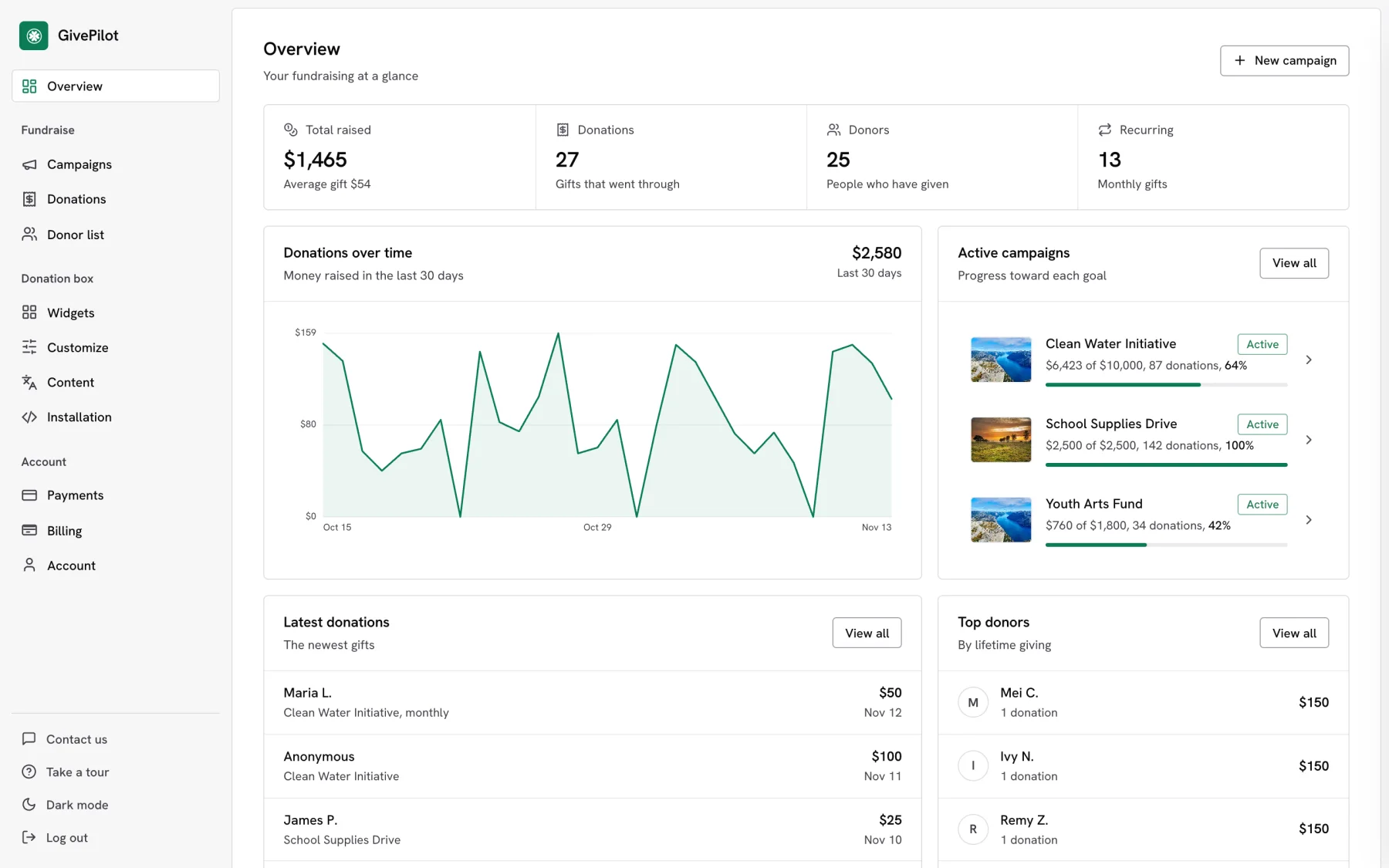
GivePilot is a website donation tool. It runs on Wix through its own app and on Shopify or any other site with two lines of code, and it pays gifts straight into your Stripe, PayPal or Square account.
Best for: any nonprofit with a website people visit. This is the core tool for most organizations.
Type 2: Crowdfunding platforms
Crowdfunding sites host a fundraiser page on their own domain and are built for sharing. Some bring an audience of browsing donors. They shine for one-off, urgent appeals that you plan to push hard on social media. Our roundup of the best donation sites compares the main hosted options.
Best for: emergency appeals and causes with no website yet.
Type 3: Peer-to-peer fundraising
Peer-to-peer tools let supporters create their own pages that raise money for you: runners, birthday fundraisers, team challenges. The platform tracks each fundraiser’s total and rolls it up to your campaign.
Best for: organizations with a motivated base of supporters and an annual event.
Type 4: Event and ticketing tools
Galas, auctions and fun runs need ticketing, check-in and auction bidding. Dedicated event tools handle these well, though they are rarely the right home for everyday giving.
Best for: organizations where events bring in a large share of income. Our nonprofit fundraising ideas include events sized for small and large teams.
Type 5: CRM suites
Donor CRMs keep records of every supporter, track relationships and run stewardship programs. Most add donation forms. They are powerful, and they take time to set up and to keep clean.
Best for: teams with a development officer and hundreds of repeat donors.
How the types fit together
| Your situation | Core tool | Add later if needed |
|---|---|---|
| A website and steady small gifts | Website donation tool | Monthly giving on the same tool |
| A website and one big annual appeal | Website donation tool with campaigns | Peer-to-peer for the appeal |
| No website yet | Crowdfunding page | A website donation tool once the site is up |
| A gala every spring | Website donation tool | An event and ticketing tool |
| Hundreds of repeat donors and a fundraiser on staff | Website donation tool for collecting gifts | A CRM for relationship management |
What to look for in your core tool
- Gifts on your own site. Your website is where people learn about your work; let them give there.
- Nothing taken from each gift. Prefer a flat plan or a free plan over a percentage that grows with your success.
- Monthly giving. Offer it in the same box, with receipts for every renewal and self-service cancellation.
- Campaigns. A goal, a deadline, photos, updates and a progress bar people can watch move.
- Your payment provider. Stripe, PayPal or Square, paid into your own account.
- Receipts. Instant, in your organization’s name, with replies to a real inbox.
GivePilot covers every item on that list. Campaigns come on every plan, Free included, with up to five photos each, story updates and messages of support from donors; monthly giving and receipts from your own email address arrive on Grassroot.
Before you pick a platform, see what peers achieve online in our nonprofit fundraising statistics, including donor retention rate and average gift by sector.